
Hearing screening

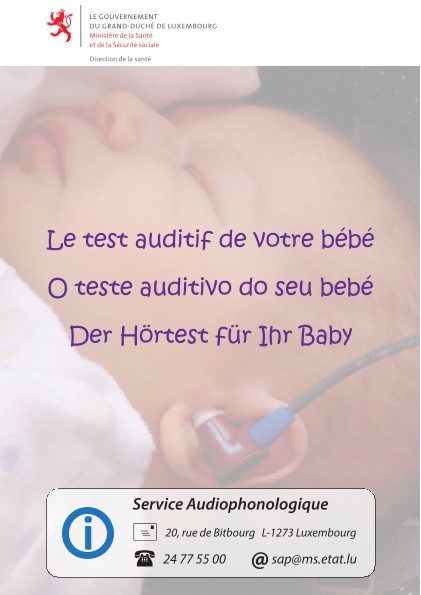
The hearing test for your baby
Your baby will undergo a series of tests during the first weeks of life. These tests include a quick and painless hearing screening.
Why test my baby’s hearing?
Each year, a small number of babies are born with a hearing loss. The early identification of a hearing problem is very important so that appropriate help can be given as soon as possible. Early intervention minimizes the effects of a hearing loss on a child’s development.
When will the test take place?
The test usually takes place during or after the second day after your baby’s birth. Testing is carried out in your room at the maternity hospital, preferably whilst your baby is asleep. If you return home from the hospital before the test has taken place, the Service audiophonologique will automatically send an appointment for the test to be carried out at their premises.
How does the test work?
A small earphone placed in your baby's ear canal sends out sounds that stimulate the hearing cells in the inner ear and makes them vibrate. As these cells vibrate, they produce a faint sound that can be recorded by a microphone in the earphone. If this sound is recorded, it proves that the ear is working properly.
The results are obtained immediately at the end of the test.
What does a negative test mean?
This does not necessarily mean that your baby has a hearing problem. Very often the test is altered by obstacles that prevent the passage of sound to the microphone (earwax, amniotic fluid, mucus, bath water, noise).
If the results are negative, a second test will be carried out in the following days. If the results of the second test remain negative, an ENT consultation is recommended to determine the cause of the negative results.
What happens next…?
Keep a close eye on your child's hearing during the first few years of life. Visit this page for more information, particularly concerning signs of hearing problems.
Dernière modification le