
Radiation protection for patients
Fundamental principles of radiation protection
With regard to patient radiation protection, there are 2 fundamental principles:
- justification,
- optimisation.
Principle of justification
The requesting physician (the doctor who requests a medical imaging test) and the administering physician (the doctor who performs the test) must both ensure that the procedures are justified.
Using ionising radiation on patients is never risk-free, even at very low doses. For this reason, medical imaging examinations may only be requested and carried out by doctors, and are always their responsibility.
Requests justified by the requesting physician
The doctor requesting a medical imaging procedure must always aim for the examination that is best suited to the patient, based on the clinical context.
The Guide to the good use of medical imaging examinations, known as the GBU, prepared by the French Radiology Association and the French Nuclear Medicine Association is a key tool for the requesting physician. It helps the doctor to choose the most appropriate examination based on pathology.
The requesting physician is not obliged to strictly apply the recommendations in the GBU but should strive to refer to it insofar as possible.
The request for an examination must be made in writing. The request must include sufficient information to justify the choice of examination – in particular:
- the purpose of the examination,
- clinical indications,
- any examinations already carried out,
- if the patient is pregnant.
To make it easier to adhere to the law, doctors who request medical imaging examinations are invited to make use of the form 'medical imaging request'.
Procedures justified by the doctor administering them
The doctor administering the examinations must check whether the examination requests received are medically justified. They must validate them before administering the examinations. If a doctor does not believe that a requested examination is necessary, they may replace it with another examination instead.
The doctor administering the examination must consider:
- the recommendations of the GBU with regard to the request criteria,
- previous diagnostic information,
- whether the patient is pregnant or breastfeeding in the case of nuclear medicine,
- alternative techniques available.
All medical imaging procedures carried out using ionising radiation must be carried out under the responsibility of a doctor. The technical realisation may be delegated but only to a medical technical assistant in radiology and always under the responsibility of an administering doctor.
All radiological examinations must be medically justified.
Radiological examinations are not carried out on asymptomatic patients unless:
- there is individualised and documented justification based on recommendations for good practice.
- within the context of and in accordance with the conditions of a national medical testing programme. Mammography is an early screening test for breast cancer.
Luxembourg has a Mammogram Programme.
It is aimed at all women from the age of 45 to 74. The recommendation is for this group to have a free mammogram every 2 years to screen for breast cancer. This national programme forms part of the wider European Mammogram Programme.
Scientific studies have shown that the benefits of this screening test outweigh the risks associated with ionising radiation. Detecting cancer at an earlier stage offers undeniable benefits to the patient.
This screening test makes it possible to:
- detect smaller cancers;
- reduce the number of breast biopsies,
- increase the number of cases where the breast is saved,
- reduce the number of deaths linked to breast cancer.
Principle of optimisation
In other words, patients’ level of exposure to ionising radiation must be kept as low as reasonably achievable, in view of the medical objective being pursued.
This principle stems from a general precautionary principle: the ALARA principle, namely As Low As Reasonably Achievable.
The European Union and the Ministry of Health have established diagnostic reference levels for the most common medical imaging examinations. These reference levels are not maximum doses that should never be exceeded. They ensure that the principle of optimisation is applied and that good practice is followed.
These good practices include:
- use of appropriate equipment,
- regular equipment checks,
- correct use of equipment,
- evaluation of doses administered and image quality.
Principle of dose limitation
There is a third principle regarding the limiting of doses. This principle applies to workers and the public, but does not apply to patients.
Only the principles of justification and optimisation are taken into account when considering the protection of patients from radiation.
In medicine, it is important that exposure doses are sufficient for examinations and therapies to achieve the desired health benefits for patients.
With regard to personnel working in medical imaging or radiotherapy, it is important not to exceed an annual dose of 10 millisievert. Staff therefore always wear devices to measure their exposure. These devices are called dosimeters.
Pregnant women are subject to a lower dose limit (1 millisievert). It is always strongly recommended that women inform their employer that they are pregnant as soon as possible.
Key points with regard to radiation protection for patients
- Recommendations of the Scientific Council with regard to requests for radiological examinations (GBU).
- Authorisation to practise radiodiagnostics based on training in radiodiagnostics and radiation protection.
- Continuing training in radiation protection.
- Authorisation of radiological equipment.
- Receipt of radiological equipment by a medical physics expert and acceptance of radiology suites (in relation to personal and third-party radiation protection).
- Periodic quality assurance of radiological equipment.
- Written protocols describing, for each piece of equipment and each type of examination, the procedure for informing and preparing the patient, from technical settings to how to process the radiology image.
- Clinical audit.
- Verification of doses administered to patients – compliance with diagnostic reference levels.
- Verification of doses to which staff have been exposed.
Publications
-
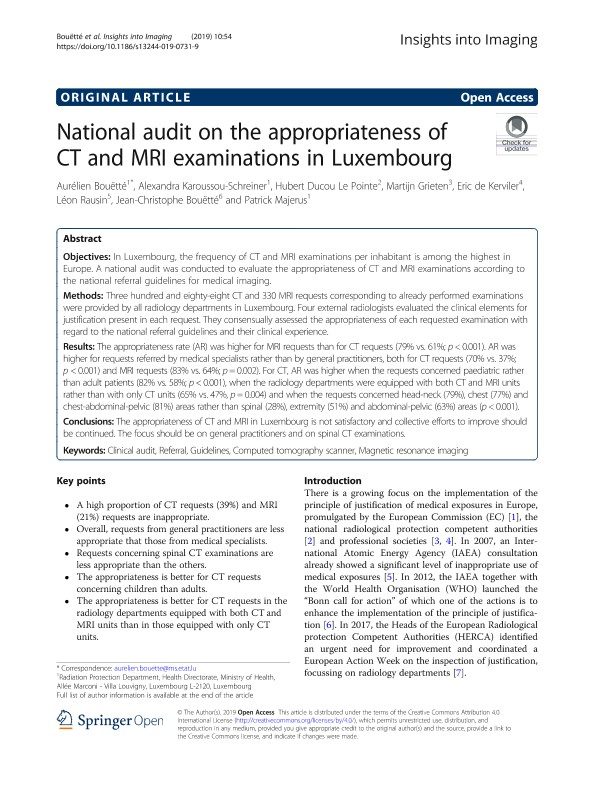
National audit on the appropriateness of CT and MRI examinations in Luxembourg
-

Audit de la conformité des prescriptions d'examens d'imagerie médicale: Volet B) Audit de la conformité aux bonnes pratiques
-
Audit de la conformité des prescriptions d'examens d'imagerie médicale: Volet A) Audit de la conformité formelle
-

Protocole d'audit de la conformité des prescriptions des examens d'imagerie médicale - Volet A) Audit de la conformité formelle
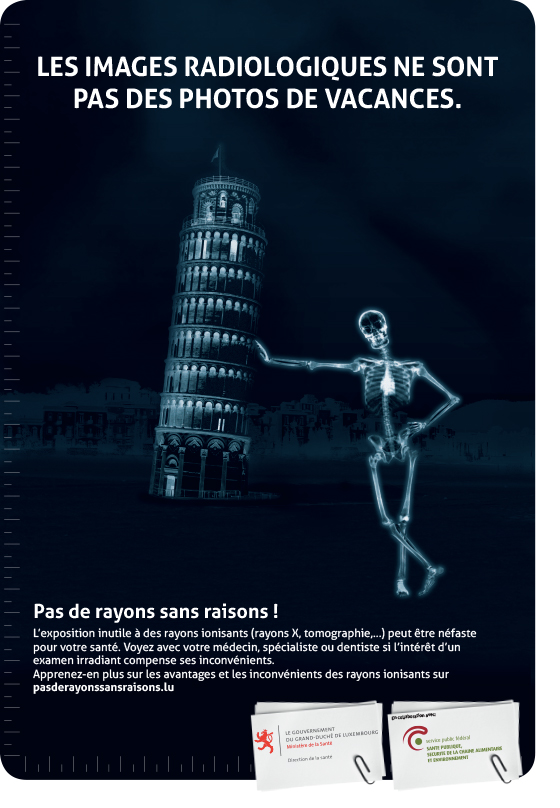
Last update