
Colorectal cancer: screening programme
Colorectal cancer
Colorectal cancer forms in the colon or rectum, together referred to as the large intestine. This type of cancer usually develops from polyps. A polyp is a benign growth on the intestinal lining that can develop into a malignant tumour.
Importance of colorectal cancer screening
In most cases, colorectal cancer does not cause any symptoms during the early stages.
Aims of screening programme
- Prevent cancer by removing polyps,
- Detect cancer as early as possible to improve the effectiveness of treatment and limit undesirable effects,
- Reduce mortality.
Target group
The national colorectal screening programme is aimed at everybody between the ages of 45 and 74 with CNS membership. Non-residents may also take part in the programme if they are members of the CNS.
How the programme works
Residents of the Grand Duchy of Luxembourg in the relevant age group will be sent an invitation by post to participate in the programme. If you have already participated in the programme, you will be automatically sent the kit along with your next invitation. You do not need to order one. Otherwise, after receiving your invitation you can order a FIT test as follows:
- Call the BIONEXT laboratory (Tel. 27 321 888) quoting your ID number and the invitation number (Voucher ID).
- Go to the website guichet.public.lu/depistage-colorectal-fr and enter your ID number and invitation number (Voucher ID).
- Go to one of the BIONEXT blood collection centres with your invitation and ID number.
- Go to a pharmacy with your invitation and ID number.
Screening method: FIT
The FIT (Faecal Immunochemical Test) looks for blood in the stool. It is the method of choice for detecting polyps and early-stage cancers that bleed.
Faecal Immunochemical Test (FIT), screening for blood in the stool
- The FIT test involves taking a stool sample in the privacy of your own home.
- It is a highly sensitive test that can detect even minimal intestinal bleeding.
Advantages of the FIT
- The test is effective.
- The test is simple to carry out: 1 sample taken at home.
- The sample is then sent free of charge to the laboratory for analysis.
- No specific diet is necessary before the test, as it only detects human blood.
Limits of the FIT
Some cancers and polyps do not bleed at the time of the test being taken and will therefore not be detected.
Even if the test is negative, it is important to consult your doctor if you have the following symptoms:
- Intestinal problems (constipation, prolonged diarrhoea, abdominal swelling, urgent and continuous need to defecate, feeling of incomplete evacuation etc.);
- Abdominal discomfort (bloating, cramps, pain, etc.);
- Blood in the stool;
- Recent loss of appetite;
- Unexplained weight loss;
- Unusual tiredness.
Our videos



Colonoscopy
If traces of blood are found in your stool sample, your doctor will decide which follow-up tests are needed – generally a colonoscopy.
A colonoscopy is the most effective method for diagnosing colorectal cancer. This involves observing the inside of the large intestine using a flexible tube with a camera on the end. The aim of the test is to find the reason for any bleeding: for example, to detect polyps (and often remove them), cancers or any other form of colon disease.
A colonoscopy is recommended for people:
- with a family history of colorectal cancer,
- who suffer from certain intestinal conditions (Crohn's disease, ulcerative colitis, haemorrhoids etc.),
- who have had colorectal cancer and require monitoring,
- who present with clinical warning signs such as chronic diarrhoea, blood in the stool and unusual weight loss.
Advantages of a colonoscopy
This test detects anomalies in the colon and small-sized polyps that can be removed immediately.
Disadvantages
- You will have to follow a low-fibre diet before the colonoscopy.
- On the day before and on the day of the examination you will need to drink a bowel preparation liquid.
- Possibility of very rare complications such as:
- bleeding following the removal of a polyp or cancerous tumour,
- perforation of the intestine with the development of peritonitis in some cases.
Publications

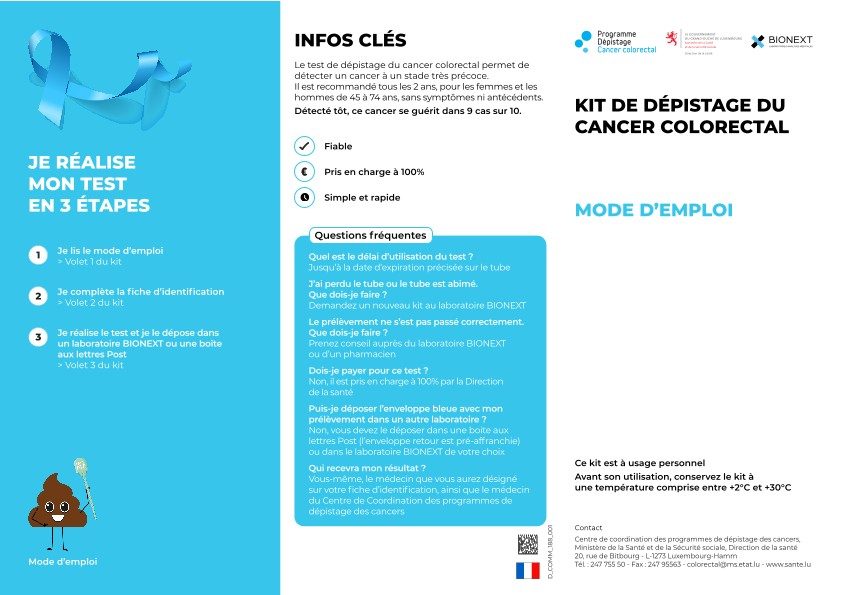
Instructions for use: Colorectal cancer screening kit
Last update