
Procedure for obtaining authorisation for a clinical trial, study or experiment in Luxembourg
Submit an application dossier
Biomedical research in Luxembourg is regulated. The Law in question stipulates that no 'clinical trial, study or experiment may be carried out on humans for the purposes of developing biological or medical knowledge without prior authorisation from the Minister, and without the opinion of the Health Directorate and the National Research Ethics Committee (Comité national d’éthique de recherche - CNER) having been sought in advance'.
In order to obtain authorisation for a trial, study or experiment, the interested party must submit an application dossier to the Ministry of Health. The Luxembourg Ministry of Health is the sole entity to which applications should be submitted. The Ministry of Health is responsible for forwarding the applications to the Health Directorate and the National Research Ethics Committee.

Stages in the application process (with the goal of authorisation)
2 questions applicants should ask themselves before submitting an application

Content of application dossier
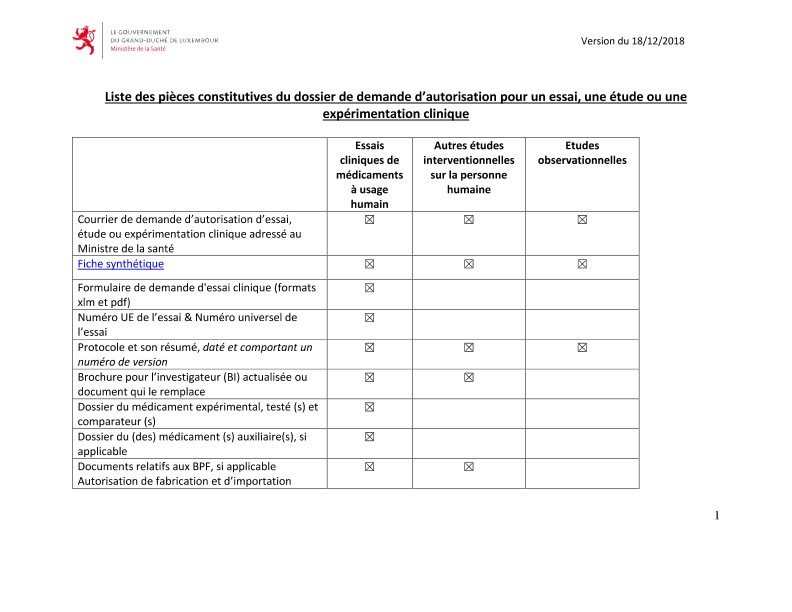
Exhaustive list of documents to be submitted, regardless of project type
- Letter of application for authorisation to conduct a clinical trial, study or experiment addressed to the Health Minister
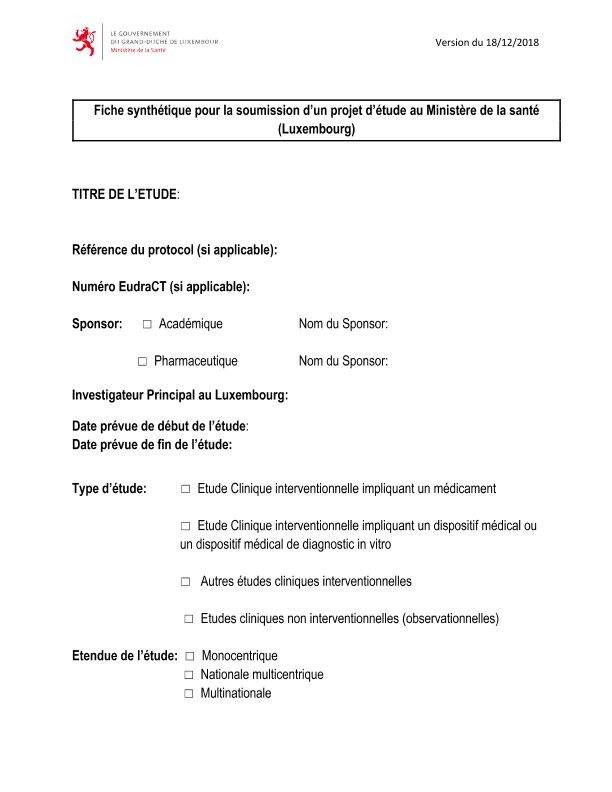
- Summary fact sheet (available below)
- Application form for a clinical trial
- EU number of trial and universal number of trial
- Protocol and summary
- Updated investigator's brochure (BI) or document replacing it
- Dossier on medicinal product(s) being investigated, tested and comparator(s), if applicable
- Dossier on auxiliary drug(s), if applicable
- Documents relating to GMP, if applicable
- Manufacturing and import licence
- Labelling of medicinal product being tested
- Scientific advice and paediatric investigation plan (PIP), if applicable
- Technical file
- Case report form (CRF), evaluation grids, questionnaires
- Qualification of investigators (CV)
- Participant information, informed consent form (French, German)
- Proof of membership of an insurance or compensation scheme
- Proof of suitable infrastructures
- Financing of the study
- Other financial provisions (compensation paid to participants, etc.)
- Proof of payment of fees
- Other useful documents
Insurance
The study sponsor must take out insurance to cover its own liability and that of all those involved in the study.
The insurance for a biomedical research project is a form of liability insurance policy.
It is based on the need to protect participants in clinical trials and is a guarantee of safety for the participants in biomedical research projects.
The object of the insurance must be to cover any potential damage suffered by participants during the biomedical research project itself, as well as any damage that could arise after such a project.
Insurance for a biomedical research project must fulfil two functions:
- Indemnify against the civil liability of the sponsor (or investigator) of the medical research. It covers any compensation due in the event of an incident during the research project, and it also covers the liability of all those involved in the research project, including the investigators;
- Compensate participants for any loss suffered as a result of their having taken part in a research project. This loss may take the form of bodily injury and/or damage to property.
Further details
In the case of research projects carried out within a hospital, the insurance certificate may stipulate that the research project must be authorised in advance by the management of that hospital. Where this applies, a document confirming that the hospital management has given its approval must be submitted to the Ministry of Health.
Where the certificate of insurance makes the principal investigator's cover conditional upon the exclusion of cover under the sponsor's insurance policy, the sponsor's insurance policy should also be attached to the submitted dossier.
Recommendations
It is recommended that the insurance certificate:
- refer to the legal framework applicable in Luxembourg;(see box below for legislative texts applicable to biomedical research)
- mention the name of the research project;
- mention the number of participants;
- mention the total amount covered for each research project;
- mention the amount covered per participant;
- stipulate the territorial coverage of the guarantee;
- mention the duration of cover.
The insurance cover must be in place for at least the duration of the research project. It may cover a period longer than the research project to cover any undesirable effects that arise after the end of the study.
How to proceed
- Application dossiers addressed to the Health Minister should be sent by email to recherchebiomedicale@ms.etat.lu.
- For files bigger than 10 MB, send an email to recherchebiomedicale@ms.etat.lu with the subject heading 'Submission of an application dossier of over 10 MB for a clinical trial, study or experiment (as applicable)'. You will then be emailed an OTX (One-Time Exchange) link that you can use to send your files.
Costs
Since the entry into force of the Law of 8 March 2018 regarding hospitals and hospital planning, the authorisation applications referred to above for the attention of the Ministry of Health are subject to the prior payment of a fee as follows:
| Research project: Clinical trial, study or experiment | Fee |
|---|---|
| Research project submitted to the Minister of Health by an industrial sponsor (or by the investigator). | EUR 1,000 |
| Academic study project submitted to the Minister of Health by a sponsor (or by the investigator). | EUR 500 |
| For any substantial change to a research project as defined in Regulation (EU) No. 536/2014 of the European Parliament and of the Council of 16 April 2014 on clinical trials on medicinal products for human use, and repealing Directive 2001/20/EC. | EUR 250 |
The above fees are payable to the Registration Duties, Estates and VAT Authority, to the bank account:
When to contact the Ministry of Health
Please contact the Ministry of Health by email at recherchebiomedicale@ms.etat.lu:
- to submit an application (an application dossier).
- when a clinical trial is subject to a substantial change as defined in Article 9 of the Grand-Ducal Regulation of 30 May 2005 on the application of good clinical practice in the conduct of clinical trials on medicinal products for human use.
The sponsor notifies the Minister of the reasons for and the content of the substantial changes and informs the Ethics Committee.
The Ethics Committee gives an opinion within 35 days of the date of receipt of the duly and properly submitted change proposal. If the opinion is not favourable, the sponsor may not change the protocol.
If the opinion of the Ethics Committee is favourable, and if the Minister has not raised any reasoned objections to these substantial amendments, the sponsor will continue to conduct the clinical trial in accordance with the amended protocol. Otherwise, the sponsor must either take heed of the objections and adapt the planned protocol change accordingly or withdraw the change proposal.
- To submit notifications of a clinical trial coming to an end and the annual safety reports.
- To send a summary of the final report or a summary of the results of clinical trials, studies or experiments.
Last update