
HBSC Study (Health Behaviour in School-aged Children)
The HBSC study is a four-yearly international study looking at the physical, mental and social health of children and adolescents, factors that positively or negatively impact their health, their health behaviour, their living environment and their social connections. The HBSC study is led by the World Health Organization (WHO) Regional Office for Europe, and covers over 50 countries. In Luxembourg, the Ministry of Health and Social Security, the Ministry of Education, Children and Youth and the University of Luxembourg are working on the project hand in hand.
This ambitious project was previously carried out successfully in Luxembourg in 1999, 2006, 2010, 2014, 2018 and 2022, with young people aged between 11 and 18 in primary or secondary education. Data is collected using an anonymised questionnaire, which has been standardised and approved at both national and international level. This means data can easily be compared across participating countries. The data thus collected forms an extensive database and is used to study and analyse young people's demographic and personal situation, their health and well-being (in terms of physical and psychosocial health), their lifestyles and their environment (smoking, alcohol and drug consumption, exercise, diet, sexuality, friends, leisure, family, school-related aspects of health, etc.), and how they shift over time.
The objectives of the HBSC study are:
- improve knowledge about children and adolescents' health and well-being and the factors that influence them,
- promote scientific research into children and young people,
- provide scientific support for the development of policy relating to children and young people.
In 2017, the Ministry of Health and Social Security, the Ministry of National Education, Children and Youth and the University of Luxembourg set up a joint website devoted specifically to HBSC surveys: www.HBSC.lu.
Publications
-
HBSC: Comportements liés à la santé des enfants et adolescents en âge scolaire au Luxembourg
-
HBSC: Santé mentale et bien-être des enfants et adolescents en âge scolaire au Luxembourg
-
HBSC: Comportements à risque des enfants et adolescents en âge scolaire au Luxembourg
-
HBSC: Contexte social des enfants et adolescents en âge scolaire au Luxembourg
-
HBSC: Impact de la COVID-19 et tendances 2006-2022 de la santé des enfants et adolescents en âge scolaire au Luxembourg
-
HBSC International Report - Mental health and well-being - WHO Europe
Factsheets
-
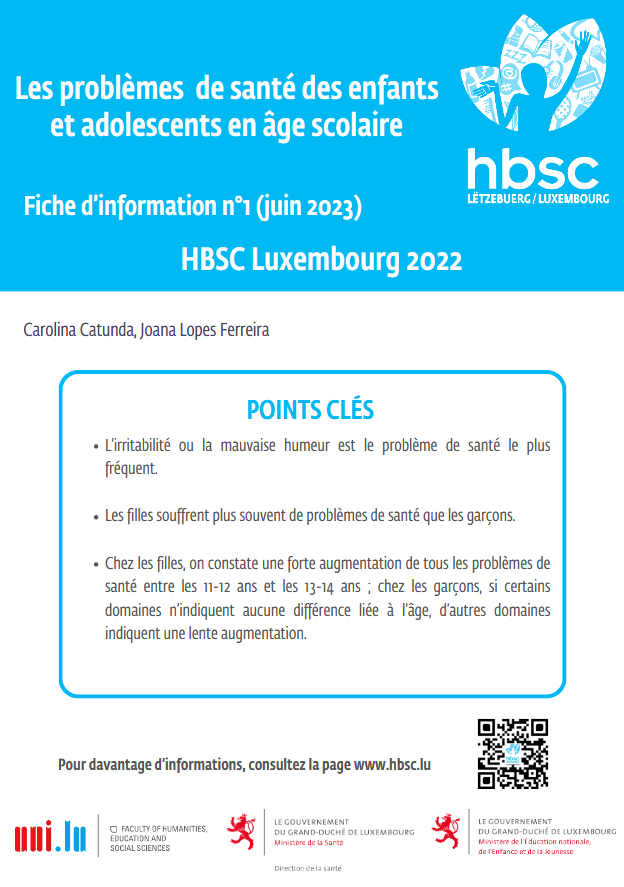
Les problèmes de santé des enfants et adolescents en âge scolaire (Factsheet n.1)
-

Activité physique, alimentation etstatut pondéral des enfants et adolescents en âge scolaire (Factsheet n.2)
-
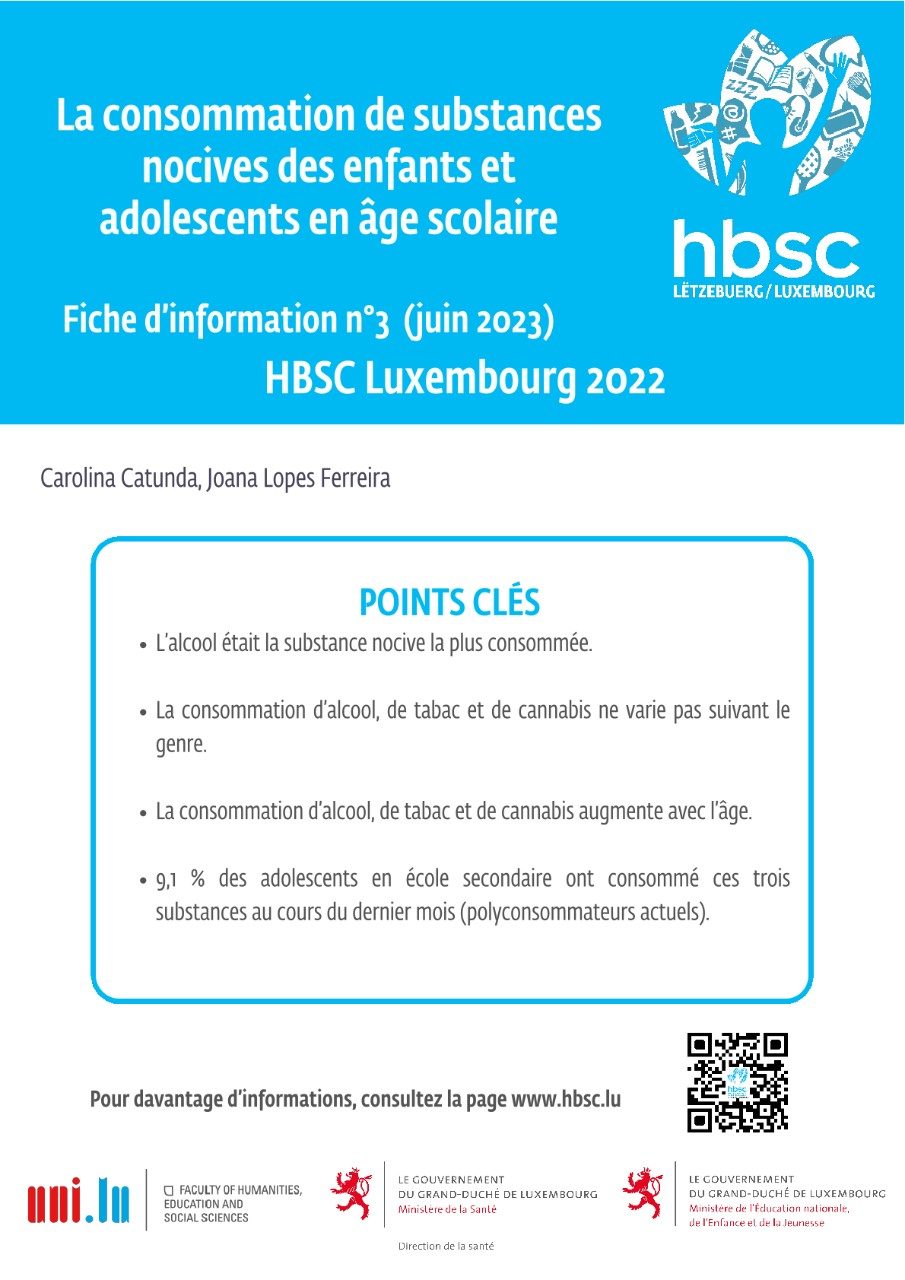
La consommation de substances nocives des enfants et adolescents en âge scolaire (Factsheet n.3)
-

Appréciation de l’école et perception de la pression liée au travail scolaire chezles enfants et adolescents en âge scolaire (Factsheet n.4)
Last update