
Identifying problems with language development
Children learn at their own rate and language acquisition is individual. However, there are some signs that can help with early identification of delayed language development.
Watch out for these signs in your child
- Your baby does not react to noise.
- Your baby does not try to communicate with you through eye contact.
- Your 6-month-old is producing fewer and fewer sounds and their babbling is not developing.
- Your 12-month-old does not try to communicate with gestures or sounds.
- Your 16-month-old has not said their first word and does not spontaneously imitate sounds.
- Your 24-month-old does not use at least 50 words.
- Your 24-month-old is unable to describe an object on demand.
- Your 24-month-old has trouble chewing and swallowing.
- Your 30-month-old does not combine 2 words to form short phrases.
- Your 36-month-old's speech is incomprehensible and unclear.
- Your 36-month-old only uses a few verbs and no prepositions, articles or adjectives.
For a detailed overview of language development in children aged 0 to 3 years old, read the brochure "Youpi, j'apprends à parler".
Treatment
Language development problems can be treated as soon as the first symptoms appear.
Once a team of specialists (speech therapists, doctors and psychologists) has identified the causes of the speech disorder, an appropriate plan can be put in place and you can be given guidance on how to give your child the best possible stimulation.
If you have questions about your child's language development, don't hesitate to contact the Audiophonology Service (Service audiophonologique).
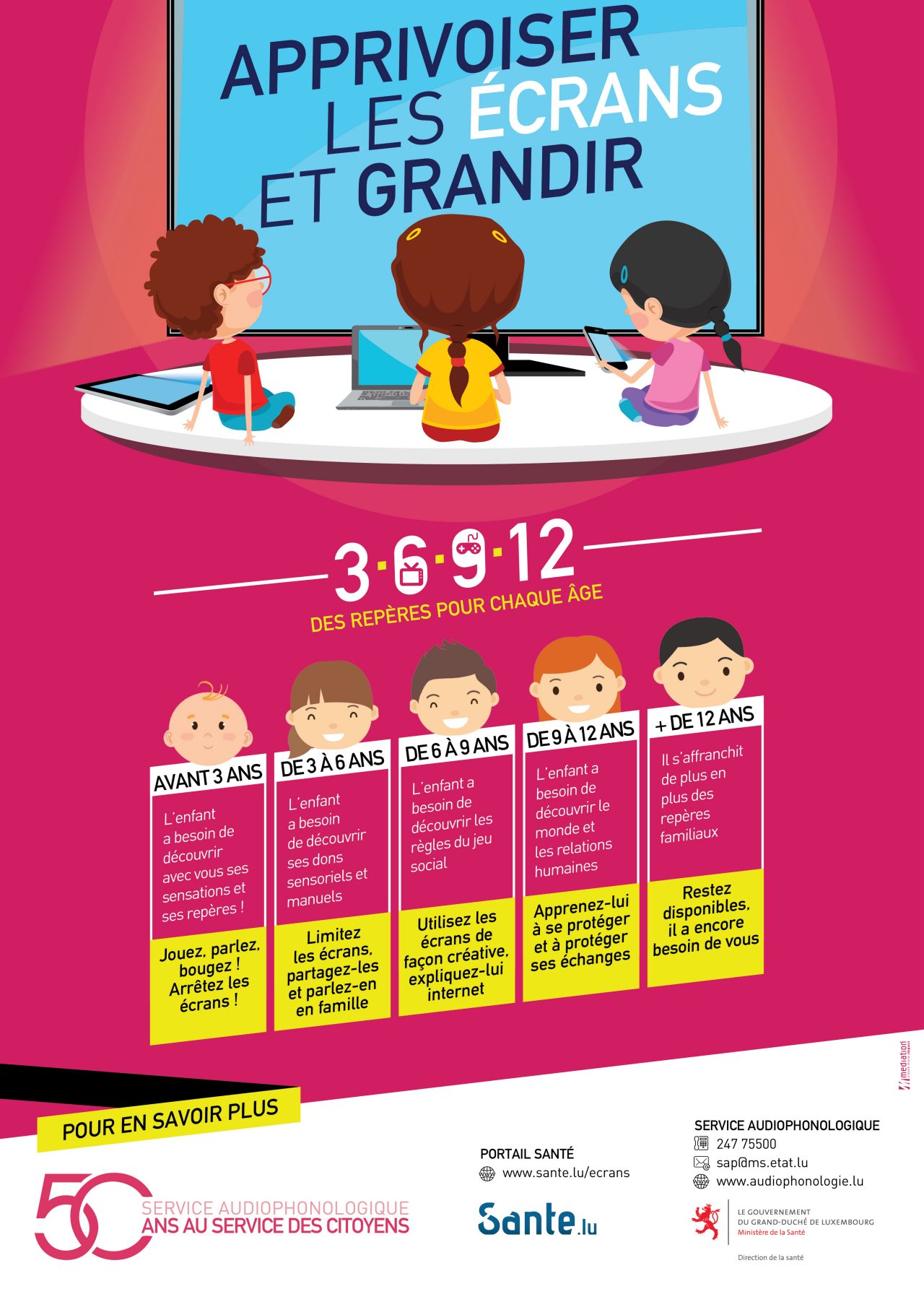
Apprivoiser les écrans et grandir
Last update