
Screen use recommendations
The advent of portable screens and the universal availability of entertainment content have contributed to children being increasingly exposed to different media from a very young age. Combined with a decrease in parental availability, the consequences of this overexposure on the psychocognitive, social and emotional development of children are significant.
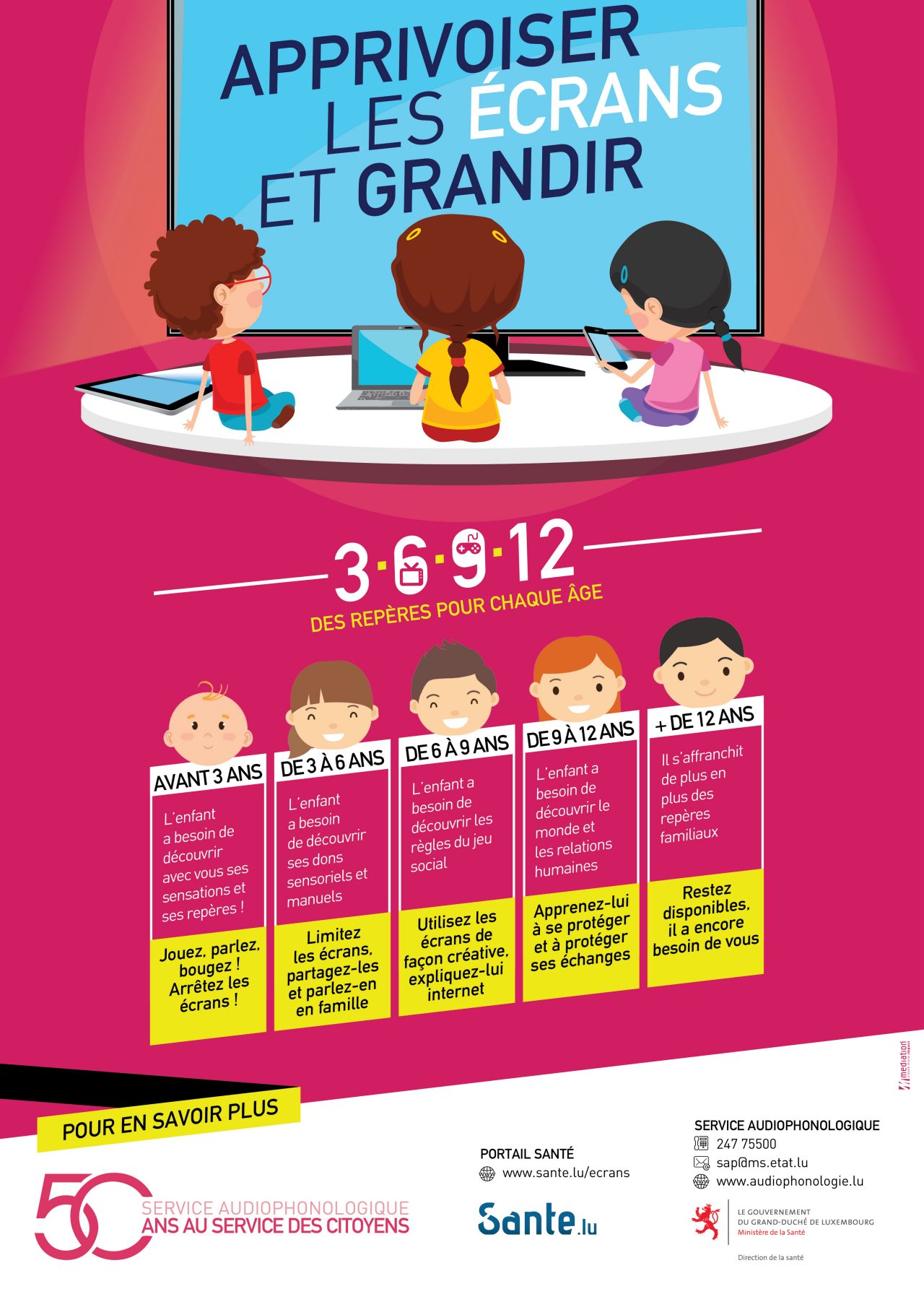
With a view to helping parents and professionals tailor children's use of different types of screen according to age, the Ministry of Health and Social Security recommends the principles of the '3-6-9-12' campaign developed by Dr Serge Tisseron to teach children both how to use screens and how to do without them.
The 3-6-9-12 principles for adapting screen use to a child's age
Before the age of 3
In the first few years of life, children develop the foundations on which their social, emotional, cognitive, motor and communication skills will subsequently be built. These foundations are constructed through all their interactions with the environment around them, based on children's 5 senses.
- Your child needs human and material interactions to construct their foundations.
- Playing and moving with your child, and talking to them, are the best ways of encouraging their development.
- A switched-on TV is harmful to your child's learning, even if they are not watching it.
- Use touchscreen tablets in a fun way in the same way as all traditional toys, but not before the age of 2 and never for more than 10 to 15 minutes a day.
- Try not to think of digital tools as a way of learning.
From 3 to 6 years old
- Avoid having screens in your child's bedroom!
- Limit their screen time to short, clearly defined periods.
- Respect the age classifications for films and apps, and remember that playing with several different ones is better than just one. At this age, playing alone quickly becomes stereotypical and compulsive.
- Ban screens at mealtimes and before bed.
- Do not use digital devices to calm your child down.
From 6 to 9 years old
- Set clear rules on screen time and discuss what they are seeing and doing on devices.
- Make sure that they continue with physical and social activities.
- Keep tablets, TVs and computers in the living room or office, not in the bedroom.
- Set up the games console and computer correctly.
- Guide your child as they get started on the internet and talk to them about the right to privacy and the right to control their image.
From 9 to 12 years old
- Continue to set clear screen time rules.
- Determine with your child the age at which they can get a mobile phone.
- Set rules for internet use and regularly remind them of the 3 basic rules:
- Anything they put online can become public;
- Anything they put online will be there forever;
- Don't believe everything you find online.
Over 12 years old
- Your child surfs the web on their own but agree a schedule with them.
- Turn off the Wi-Fi and don't let them stay logged on all night.
- Discuss downloads, plagiarism, pornography, bullying, etc. with them.
- Refuse to be their 'friend' on Facebook.
Family rules... for everyone
These rules will help you get to grips with screen use in your household.
- From the outset, set clear rules about the use of digital devices. Even if your children do everything to convince you there is no need to set rules, they have more flexibility than you think.
- Limit screen time, choose programmes together, talk about what you've watched and use it to be creative.
- Do not leave your child alone glued to their screens. Join your child when they are watching a film and choose games consoles with multiplayer games.
- Stop your child from taking digital devices to bed. They will struggle to put them down and the blue light emitted by screens disrupts sleeping patterns and sleep quality.
- Sit down to eat and make meals an opportunity to spend time together without your screens.
- Don't keep picking up your own smartphone and avoid watching TV during family time. Children are very prone to imitation and you are their main example.
- Determine a place where all members of the family put their phones during meals and after a certain time in the evenings.
- Try to watch age-appropriate films rather than TV programmes. The length will always be limited and your child can watch each film several times until they have understood it.
- Explain that digital devices belong to the family as a whole to stop your child from feeling like they own a particular console or tablet. That way, it will be easier to control their use.
Apprivoiser les écrans et grandir
Last update